STAR Method Story Formatter for Sri Lanka
Format your behavioral interview stories using the STAR (Situation, Task, Action, Result) framework, tailored for top software engineering and corporate roles in Colombo.
1. STAR Framework Inputs
2. Formatted STAR Output
STAR Method Story Formatter: Complete User Manual & Guide
Behavioral interview questions—such as “Tell me about a time you handled a crisis under pressure” or “How did you resolve a major technical bottleneck?”—are standard screening tools used by engineering managers and enterprise recruiters across Sri Lanka. Candidates often struggle not because they lack technical experience, but because their answers lack clear structure.
The STAR Method Story Formatter for Sri Lanka on tjncareers.online solves this challenge. It provides a guided interface to organize raw career experiences into a structured narrative: Situation, Task, Action, and Result. This guide details every field, feature button, and strategic practice to help you master behavioral interviews.
1. Tool Overview & Core Benefits
The formatter translates individual experience points into a cohesive, articulate narrative designed to demonstrate technical expertise and quantifiable business impact.
Primary Tool Advantages:
-
Structured Narrative Alignment: Guides you through each pillar of the STAR methodology so key technical achievements are presented clearly.
-
Recruiter-Ready Output: Formats raw notes into clean, structured paragraphs ready to copy and practice before interviews.
-
Targeted for Local & Remote Hiring: Tailored to meet the evaluation standards of IT firms, banks, and multinational engineering offices in Colombo and major tech hubs.
2. Navigating Section 1: STAR Framework Inputs
The left pane collects the foundational components of your behavioral story.
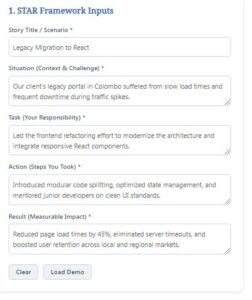
Form Input Breakdown:
-
Story Title / Scenario: Enter a brief, descriptive headline to identify the scenario (e.g.,
Legacy Migration to React). -
Situation (Context & Challenge): Describe the background, team environment, or technical bottleneck (e.g., “Our client’s legacy portal in Colombo suffered from slow load times and frequent downtime during traffic spikes.”).
-
Task (Your Responsibility): Detail your specific role or assignment within the scenario (e.g., “Led the frontend refactoring effort to modernize the architecture and integrate responsive React components.”).
-
Action (Steps You Took): Outline the concrete technical steps, methodology, and problem-solving strategies you executed (e.g., “Introduced modular code splitting, optimized state management, and mentored junior developers on clean UI standards.”).
-
Result (Measurable Impact): State the quantifiable metrics, business value, or efficiency gains achieved (e.g., “Reduced page load times by 45%, eliminated server timeouts, and boosted user retention across local and regional markets.”).
3. Form Control Actions
-
Load Demo (Gray Button): Click Load Demo to populate all fields with a complete sample story. This helps you inspect the structured output rendering before drafting your own stories.
-
Clear (Gray Button): Click Clear to wipe all text boxes and reset the form for a new interview preparation session.
4. Navigating Section 2: Formatted STAR Output
The right pane renders your structured behavioral story, complete with one-click export controls and interview tips.
Execution Workflow:
-
Review Narratives: Verify that the generated output transitions smoothly between the initial context, your direct execution, and the final business impact.
-
Copy Story (Blue Button): Click Copy Story at the top right of Section 2 to save the formatted text to your clipboard.
-
Preparation & Notes: Save the output in your personal interview preparation master sheet or document.
5. STAR Framework Breakdown & Strategic Weighting
When delivering your formatted story verbally, balance the time spent on each component to maintain recruiter engagement:
| STAR Element | Recommended Verbal Time Allocation | Primary Candidate Objective |
|---|---|---|
| Situation | ~15% of spoken answer | Set the stage briefly without getting lost in unnecessary background details. |
| Task | ~10% of spoken answer | Clearly define your individual ownership and explicit responsibility. |
| Action | ~50% of spoken answer | Detail your personal technical execution, tools used, and leadership actions. |
| Result | ~25% of spoken answer | Highlight concrete business outcomes, performance metrics, or key takeaways. |
6. Best Practices for High-Impact Behavioral Stories
-
Focus on Metrics: Use percentages, saved hours, or currency figures whenever possible in the Result section. Quantifiable data builds immediate credibility.
-
Emphasize “I” Over “We”: While teamwork is important, make sure the Action section focuses explicitly on your specific contributions and decision-making process.
-
Build a Story Bank: Prepare 4 to 6 core STAR stories covering different scenarios: technical conflict, system failure, leadership under tight deadlines, and complex feature implementation.